We need to be very strategic and support the most essential value chains** – those value chains that are critical for food security and economic growth need to be protected – that means that all actors should coordinate to protect those value chains, negotiating with governments on less stringent regulations, supporting access to inputs and market linkages, and promoting better storage and processing capacity to avoid waste.
2 Likes
Agree on the need for more innovation in alternative financing vehicles! At the Collaborative for Frontier Finance (www.frontierfinance.org) we are working with a group of early stage capital providers on this topic and are exploring building a series of case studies / models that present sustainable alternatives to the traditional “2/20” PE structures that may not be best suited to meet the needs of financing entrepreneurs in emerging markets.
3 Likes
I agree that co-creation and collaboration is the way to go. But the approach needs to be more scalable. A consortium approach is needed not only with the right companies but with a cross functional team within those companies. Sales, strategy. Data management, insights, CSR, foundations. But we also need to define a set of guidelines on how to approach this from a consortium perspective and define the minimum viable blue print to enable successful collaborations.
2 Likes
A2:
Boston Consulting Group, CEMEX, Telefónica, Airbus BizLab, BASF, BID Lab, Citi, Endeavor, IE, IESE Business School, Microsoft for Startups and South Summit are organizing “Restarting Together”, a global challenge for startups and small and medium-sized enterprises (SMEs). The initiative is designed to contribute to a fast-economic recovery and create a more resilient society in the face of a crisis like the current pandemic.
Restarting Together would select three winners to share their vision with global leaders from the supporting companies. The three winners would enjoy the possibility of receiving access to corporate resources from the organizing companies, including potential acceleration or investment. Additionally, all proposals should be available for development, promotion, and implementation by all, or some, of the companies organizing Restarting Together.
You can find more at: https://restartingtogether.com
1 Like
Palladium has developed and tested an Inclusive Growth Framework to build long term mutually beneficial relationships between large companies and MSMEs through the modernization of their business ecosystems. This can involve supply chains and distribution systems for both goods and services. The key is to bring together secure access to markets, the know-how and technology needed to competitively ensure market requirements and ensure viable businesses and incomes, and the system financing needed to achieve this. Our experience shows that the key to success are catalysts that can integrate the key actors in this ecosystem, but most critically, structure commercial and blended financing. Palladium is now setting up project development facilities and financing and service platforms, especially in the agroforestry and forest regeneration space in Latin America and Asia. These are being structured to channel hundreds of millions of dollars to thousands of MSMEs, but anchored by large corporate offtakers and investors
3 Likes
I see a trend about collaboration between different market actors coming out from some posts; for example, from @Christina_Tewes-Grad, @hringholz and @jorgeortega. I am deeply interested in this. In particular, the role of “systemic facilitators” on the ground, creating convergence and alignment between stakeholders.
I wanted to know more about these facilitators in your contexts. Especially, those who do not belong to donor-funded programmes. Who are they? How do they work? Who pays for their work? How do they acquire their skills?
I am looking for strategies to enable these facilitators and find financing mechanisms that mean that they get paid by the systems they help to improve.
Thanks for any insights you can share.
3 Likes
3/4 That matchmaking and preparation on both sides is where we see our own role. We scout social businesses that fit the sourcing criteria of corporations.
Once we find the right shortlist of social businesses (based on challenges or opportunities identified by the corporation), we moderate the relationship between the two parties – usually 2-6 months depending on the complexity of the individual partnership. Ultimately, we want to build the necessary trust between both to form long-term relationships and complement them with building the supportive ecosystem (including public players, NGOs, etc.).
So in our humble, small way we are aiming to preserve the best of both worlds – relentless impact-focus and agility on the side of social businesses and scale and execution power of corporations.
2 Likes
we are trying to work with some of our old school customers and reducing transaction costs and ease of obtaining raw material is working for us. must admit covid situation has provided a push. Shift to digital must create benefit in core operations
2 Likes
@danielnowack ANDE is working with Mastercard but I dont believe I seen that particular survey. Is it targeted at MSMEs only? Please share link if you can. Thanks.
1 Like
Even though MSME’s are the pulse of the real economy and generally recognised as drivers of industrialisation, economic growth and employment generation, and remain a large source of income, particularly in low-income households. The nature and structure of economic activity in our countries indicates certain sectors feature more prominently, and makes up the majority of economic activity which varies from country to country.
In Malawi 94% of MSMEs (excl. farmers) are involved in one of four sectors: wholesale and retail (69%), agriculture (16,5%), community and household (4,5%) and manufacturing (3.8%).
In Lesotho: 30% of MSMEs are in trade, 22% in agriculture, forestry and fishing, 10% in accommodation and food services, and 9% in manufacturing.
In Eswatini, 89% of MSMEs are involved in four sectors: Wholesale and retail trade (39%), agriculture (23%), community and household (14%), and manufacturing (13%).
Wholesale and trade is largely survivalist and these will need short term support – while recognising that they need long-term vision in terms of how to grow and evolve them so that they contribute to national growth. Agriculture is a significant MSME activity and it will be key to focus sectoral activity on agriculture as well as defining which other sectors to grow in a post-covid 19 world. MSME activity on the ground is very different from commonly assumed sector contribution to GDP and will need a more coordinated vision and approach taking into consideration a multi-sectoral approach.
1 Like
4/4 There are some great examples out there. IKEA, for example, has been working with several organizations from the impact sector, including YSB, to strengthen their social sourcing. As a result, they have just been ranked as one of the leaders in the Material Change Report by the TextileExchange – joining patagonia in this category. And their activities span various categories of input materials.
On the other hand, we need to provide the right plumbing to connect MSMEs and social businesses with MNEs. In many cases, it is simply a lack of visibility and network that prohibits small ventures to procure to MNEs. I am hopeful that initiatives like SAP’s push to list social entrepreneurs on their sourcing platform Ariba will be one of many angles to connect social businesses with corporations. But it always needs to be accomodated by integration of these ventures into a nurturing ecosystem.
3 Likes
A2: The most important thing is for investors to continue to invest: don’t abandon the agri-MSMEs, as they truly are the most effective platform to create positive impact for their rural communities. Root Capital has been building the field of smallholder agricultural finance for more than 20 years. We have demonstrated that these businesses are bankable. Yet, these enterprises require patient, blended capital - philanthropic capital as well as traditional capital.
One example is the Coalition for Farmer-Allied Intermediaries. Organized by Bain & Co, this group is bringing together international practitioners to strengthen farmer-allied intermediary businesses that anchor local food systems in sub-Saharan Africa (members include Root Capital, TechnoServe, Partners in Food Solutions, Land O’Lakes Venture37, Acumen, and Bain & Company). We will start in key geographies in East and West Africa based on our collective base of ~600 intermediary businesses, working across value chains with immediate focus on providing local populations with nutritious food. Our goal is to equip intermediaries with the required capital and strategic, financial, and operational capabilities to ensure business continuity and adaptation to survive through the COVID-19 crisis and help them grow sustainably and profitably. We aim to raise and deploy ~$100M through a variety of financial instruments to provide a capital continuum to support businesses throughout their growth. And we’ll use our knowledge of these businesses, grant recovery, and soft debt repayment history to establish enterprise “creditworthiness” and catalyze more local commercial lending and investing in agriculture and food businesses. Importantly, we will also support industry coordination and advocacy to improve the operating environment for the food system going forward.
3 Likes
Agreed, @danielnowack - developing and using innovative financing instruments to support into this space is key. At the same time, this can only work if there is actually a return on this, even if it is a long-term one. One of the key learnings for me is that systemic change cannot be a charitable-only activity
3 Likes
Very interesting! I believe this idea of “community connectors” has lots of potential as hubs for systemic transformation.
1 Like
Post-COVID, actors should leverage an ecosystem approach in supporting the MSME sector. The ongoing alliances, platforms and partnerships tackling challenges in the sector should ideally be brought together under neutral umbrella initiatives covering specific regions. This allows for a shared understanding of challenges and increases the likelihood of actors partnering to create initiatives targeted at solving these challenges.
The Uganda Entrepreneurial Ecosystem Initiative (UEEI) is an example of a convening initiative that is bringing together ecosystem actors in 2 distinct regions of Uganda; Kampala and Gulu. The initiative is targeted at the Small and Growing Business Sector but the approach would apply to MSMEs too.
2 Likes
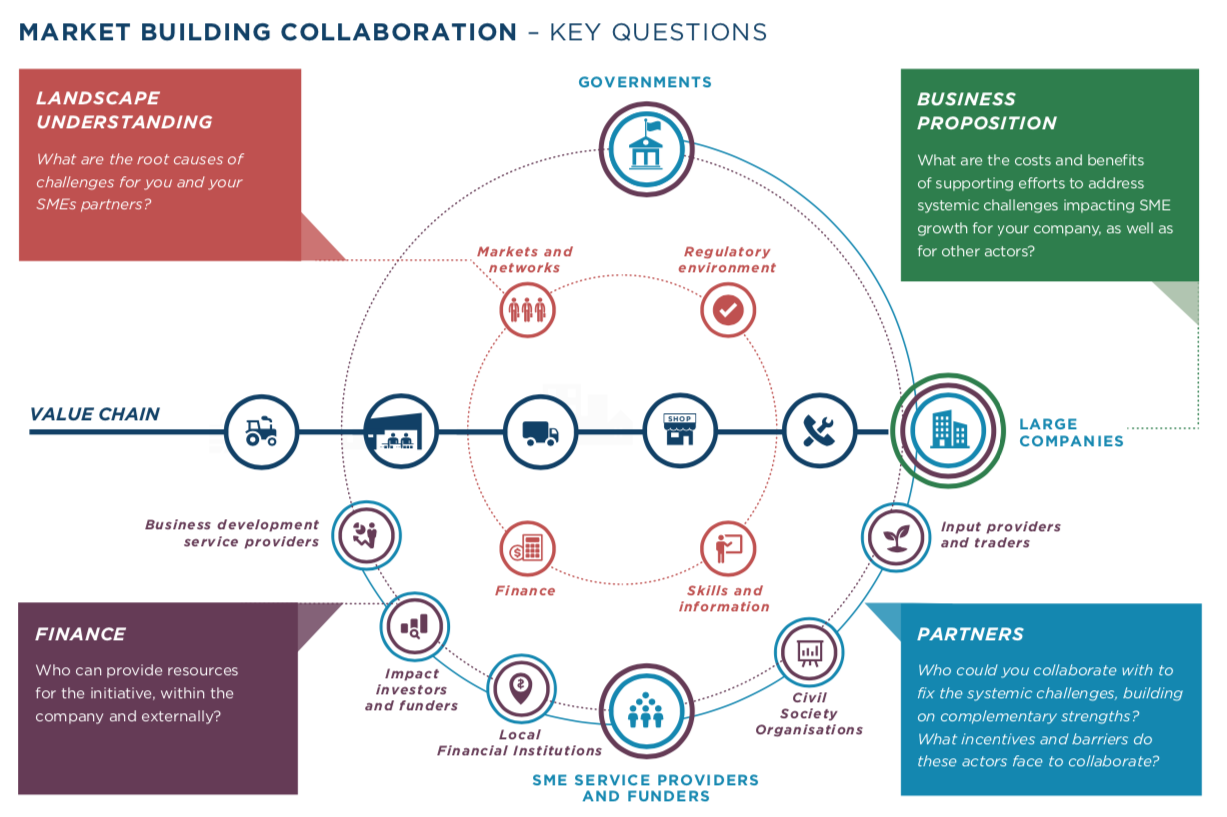
I share here the framework from the guide on the elements of Market Building Collaboration. It looks complex, but based on analysis the leverage points can be very focussed. The core is a change in mindset: from focussing on short term fixes to enabling long term growth.
5 Likes
Sure, agreed. At the same time, we do need an impact-first approach to building business models that focus on solving a social / ecological problem before they fall trap to scale requirements by investors. So hybrid financing (i.e. to derisk an early-stage model with grant financing) may be our common ground here.
3 Likes
we have UKAID funded entity called Karandaaz which is bringing different MSME actors together and supporting the ecosystem. it is a good case study. they have conducted an interesting survey also and have come up with recommendations
2 Likes
Also, another great example is Anglo American’s work on the Collaborative Regional Development programme to help transform the Limpopo province in South Africa and encourage economic development beyond mining. Anglo American has partnered with the mining company Exxaro Resources, the Council for Scientific and Industrial Research (CSIR), the Office of the Premier in Limpopo Province, and World Vision International to set up the Impact Catalyst, a backbone organisation that promotes a common agenda for development and catalyses positive socio-economic impact across the province.
Business to business partnerships also offer real potential and more should be done at a sector and industry level to enable them. Bayer’s Better Life Farming partnership globally with a group of companies operating along the agri-food value chain including irrigation technology Netafim and insurance company Swiss Re and locally in India with additional partners like Yara Fertilisers and offtakers DeHaat, AgriBazaar and Big Basket demonstrates the potential to develop more integrated solutions that simultaneously address a range of barriers that holdback smallholder farmers.
4 Likes